
Medical Photography Best Practices: Consistent Positioning for Accurate Progress Tracking
Introduction
You've just pulled up a patient's file to compare their psoriasis treatment progress. The baseline photo from three months ago was taken at an angle, under fluorescent lighting, with the patient's arm bent. Today's image is a close-up, shot near a window, with the arm extended. The photos are clinically useless for comparison.
This scenario plays out in practices every day. When the angle and the light change, the next visit cannot be compared with the last one.
This guide covers the positioning standards, lighting principles, and workflow strategies that leading medical associations recommend. The standard is the same whatever you photograph: one distance, one angle, one light, so the next visit can be compared with this one.
What is Medical Photography?
Medical photography (also called clinical photography) is the standardised capture of clinical images for documentation, diagnosis, treatment planning, and medicolegal purposes. Unlike casual photography, medical photography requires consistent positioning, lighting, and framing to enable meaningful comparison across time. The key principles include: reproducible camera distance and angle, controlled lighting conditions, standardised views by body area, and inclusion of scale references for wounds and lesions. Leading organisations including the American Society of Plastic Surgeons (ASPS) and the Wound, Ostomy and Continence Nurses Society (WOCN) have published positioning standards that ensure clinical accuracy.
Why Consistency Matters More Than Camera Quality
The most expensive camera in the world cannot compensate for inconsistent positioning. Even subtle changes in head tilt significantly affect the appearance of facial features, skin laxity, and treatment outcomes. A patient photographed looking slightly upward will appear to have less submental fullness than the same patient photographed looking downward—creating false impressions of improvement or deterioration.
Standardised photography serves three critical functions. First, it enables accurate clinical assessment by isolating treatment effects from photographic artefacts. Second, it builds patient trust through transparent, comparable documentation they can see and understand. Third, it provides medicolegal protection, since inconsistent photos cannot defend against claims of inadequate documentation or treatment failure.
Positioning Standards by Specialty
Facial Photography: The Frankfort Horizontal Plane
Plastic surgery documentation is held to the most rigorous positioning standards in medicine. Major surgical associations have codified these norms for reproducibility across time and practitioners. The foundational principle is the Frankfort Horizontal Plane—an imaginary line from the top of the ear canal (tragus) to the lower rim of the eye socket (infraorbital rim) that should be parallel to the ground.
The standard facial series includes five views: frontal (looking directly at camera), left lateral (true 90° profile), right lateral, left oblique (45° angle), and right oblique. For rhinoplasty documentation, additional views include the base view (looking up at nostrils) and a lateral smiling view to assess tip movement.
To achieve consistent positioning, have patients focus on a fixed point at eye level. Both ears should be visible in frontal views—if they aren't, you're likely too close with a wide-angle lens, creating distortion. The patient's shoulders should be relaxed and level, not hunched or rotated.
Dermatology: The Three-Shot Protocol
For dermatology photo documentation, the recommended approach captures context, extent, and detail through three sequential photographs.
The overview shot establishes anatomic location. Include recognisable landmarks—if photographing a lesion on the forearm, show the elbow or wrist for orientation. This image answers the question: "Where on the body is this?"
The medium shot captures the full extent of the affected area with surrounding normal skin visible. This provides context for size and distribution without losing detail.
The close-up shot documents morphological detail—texture, colour variation, borders, and surface characteristics. Position the camera lens perpendicular (90°) to the skin surface, with the area of interest oriented vertically or horizontally in frame, never at an angle.
For total body photography used in melanoma surveillance, the Halpern Protocol establishes 15 standardised poses covering the complete skin surface (British Journal of Dermatology, 2009). While full implementation requires 15-30 minutes per session, even simplified versions dramatically improve longitudinal tracking.
Wound Care: The Clock Method
The wound care photo tracking workflow depends on consistent measurement and orientation. The Wound, Ostomy and Continence Nurses Society (WOCN) guidelines establish clear protocols tied to reimbursement requirements and liability protection. Photograph wounds within 24 hours of admission, upon initial discovery, at regular intervals (typically weekly), and at discharge.
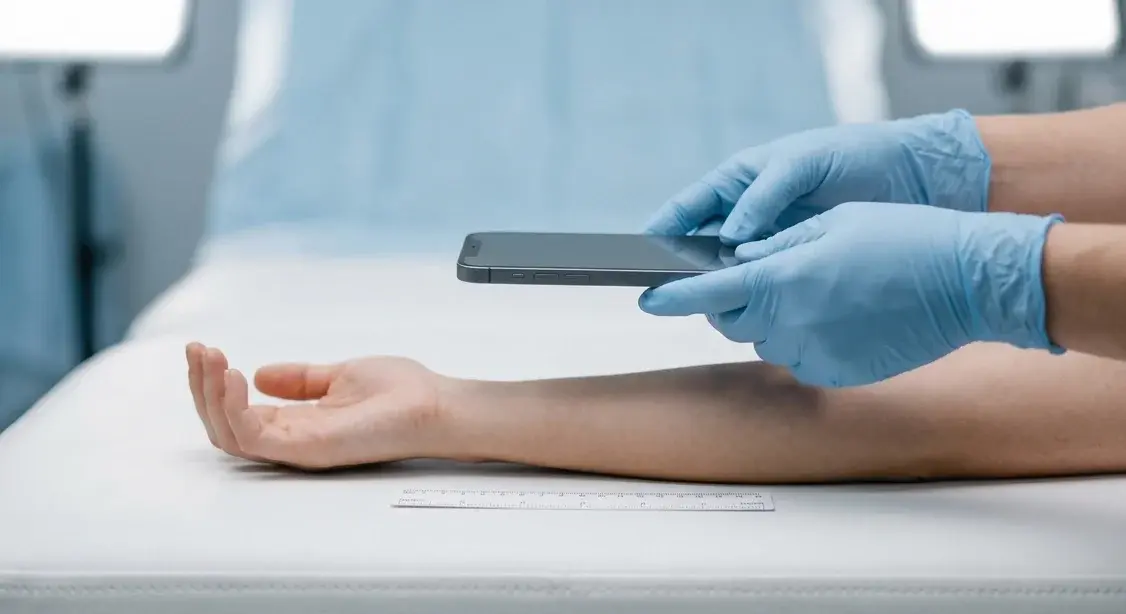
Each wound requires two photographs: an overview from approximately one metre showing anatomic location, and a close-up within 10-15cm for detail. Include a disposable ruler or measurement reference in every close-up image.
The clock method standardises measurement orientation: 12 o'clock points toward the patient's head. Length is measured from 12 to 6 o'clock (head to toe), width from 3 to 9 o'clock (side to side), all recorded in centimetres. This consistency allows any clinician to replicate measurements and compare across time.
Position your camera perpendicular to the measurement device—not the wound surface itself if the wound is on a curved body area. This ensures measurement accuracy and consistent scale across images.
Lighting: The Variable Most Practices Ignore
Lighting inconsistency rivals positioning as a source of comparison errors. A single overhead light creates shadows that emphasise texture and depth. Move that same patient near a window, and diffuse natural light flattens those same features. Neither image is "wrong," but comparing them reveals nothing about actual clinical change.
The Dual-Source Principle
Professional medical photography uses at least two light sources positioned at 45° angles to the subject. This eliminates harsh shadows while maintaining enough dimension to show texture and contour. You don't need studio equipment—two identical LED panels or even matched desk lamps positioned symmetrically can achieve consistent results.
For practices without dedicated photography spaces, identify one location with controllable lighting and use it for all clinical photography. Consistency matters more than perfection. A slightly dim but reproducible setup beats varied "good lighting" that changes with time of day and weather.
Photographing Darker Skin Tones
Standard flash photography creates problematic glare on darker skin, washing out detail and colour variation. External LED light sources angled at 45° minimise reflection while providing even illumination. If using flash, bounce it off a ceiling or wall rather than firing directly at the patient.
Cross-polarised photography—using polarising filters on both the light source and camera lens oriented perpendicular to each other—dramatically reduces surface glare while enhancing visualisation of deeper skin structures. This technique is particularly valuable for documenting subtle conditions that standard photography obscures.
Camera Distance and Lens Selection
Smartphone cameras, while convenient, introduce optical distortion that affects clinical accuracy. Wide-angle lenses make noses appear larger and faces more rounded—the "selfie distortion" effect that patients instinctively dislike. For clinical purposes, this distortion makes before-and-after comparison unreliable.
Position cameras at least one metre from patients for facial photography. Use 50-60mm equivalent focal lengths (often labelled "portrait mode" or "2x zoom" on smartphones) to achieve natural perspective. If both ears aren't visible in a frontal facial photo, you're too close or using too wide a lens.
For close-up lesion or wound photography, maintain consistent distance by using a reference object or standardised camera position. Many practitioners mark floor positions with tape or use fixed mounting systems to ensure reproducibility.
Building Consistency Into Your Workflow
Knowing standards and implementing them consistently are different challenges. The practices that succeed treat photography as part of clinical flow rather than an afterthought.
Designate a Photography Station
Identify one location with controlled lighting, neutral background, and consistent setup. This doesn't require a dedicated room—a corner with a plain backdrop and fixed lighting position works. The key is reproducibility: every patient, every visit, same conditions.
Use Visual Positioning Guides
Reference images showing correct positioning reduce variation dramatically. One training study found that only 32% of patients were correctly positioned before staff received guidance, improving to 66% after a simple two-minute training video (Dermatology Times, 2023). Display reference photos at your photography station showing ideal positioning for common documentation needs.
Ghost image overlays—semi-transparent reference images displayed on screen during capture—allow precise alignment with previous photos. This technique is particularly valuable for progress tracking, ensuring each follow-up image matches baseline positioning exactly. PixioDoc includes adjustable ghost overlay functionality specifically for this purpose, letting you select any previous patient image as a positioning reference.
Establish Capture Protocols by Visit Type
Define which photos you need for common visit types and document them in your workflow. Initial consultation for a cosmetic patient might require the full five-view facial series. A wound care follow-up needs overview and close-up with measurement. A dermatology check might need only the three-shot lesion protocol.
When staff know exactly what's expected before the patient arrives, photography becomes routine rather than improvised.
Capture Multiple Images Without Interruption
Breaking workflow to review each image individually wastes time and reduces consistency. A multi-capture approach—taking several images in sequence before reviewing—maintains patient positioning and speeds documentation.
PixioDoc's multi-capture camera is designed for exactly this workflow: capture multiple images without exiting the camera interface, review thumbnails in a strip below the viewfinder, and remove any substandard shots before saving. This approach typically cuts photography time by 40-50% compared to single-capture workflows.
Common Mistakes That Undermine Clinical Value
Inconsistent Backgrounds
Busy or variable backgrounds distract from clinical content and make comparison difficult. Use a plain, neutral backdrop—light blue is the medical photography standard—for all clinical images. Even a portable backdrop panel that rolls out for photography sessions dramatically improves consistency.
Missing Scale References
Without measurement references, images cannot support quantitative assessment. Always include rulers or measurement devices for wounds and lesions where size matters. For facial photography, consistent camera distance serves as implicit scale.
Metadata Loss
Clinical photographs should include capture date, time, and ideally practitioner identification in recoverable metadata. Photos stripped of metadata through messaging apps, screenshots, or social media lose their evidentiary value. Store and transfer images through systems that preserve original file data.
Patient Preparation Inconsistencies
Makeup, hairstyle, and clothing affect facial photography. Establish standards for patient preparation—remove makeup for skin assessments, pull hair back consistently, wear examination gowns when documenting body areas. These details compound across visits if not controlled.
Storage and Compliance Considerations
Proper technique means nothing if images are stored insecurely or lost. A 2016 survey of Canadian plastic surgeons and residents found that 57% stored clinical photos on their phone (Chan et al., Plastic Surgery, 2016).
Clinical photographs containing identifiable patient features constitute protected health information requiring encrypted storage, access controls, and audit trails. Personal device camera rolls, consumer cloud storage, and standard messaging apps typically fail these requirements.
If you're evaluating software rather than technique, our guide to what makes a medical photography app GDPR compliant breaks down the exact features to look for.
Purpose-built medical photography systems address these concerns through encrypted capture and storage, automatic organisation by patient, and compliant sharing mechanisms. PixioDoc was designed around these requirements—images never touch your personal camera roll, storage uses encryption in transit (TLS 1.3) and at rest (AES-256), and sharing occurs through secure, auditable channels (Pro). Consistent framing across visits is also what makes patient progress reports credible: PDF treatment summaries from selected sessions that patients and referrers can trust, not comparisons undermined by lighting or angle drift.
Bringing It All Together
Consistent clinical photography isn't about achieving photographic perfection—it's about controlled variables that enable meaningful comparison. The dermatologist who photographs every patient under the same lighting, at the same distance, using the same positioning guide will generate far more clinically useful documentation than one with expensive equipment and no protocol.
Start with one improvement: establish a single photography station with fixed lighting. Add positioning references for your most common documentation needs. Implement a multi-capture workflow that doesn't interrupt clinical flow. Build from there.
The time invested in standardisation pays dividends in diagnostic clarity, patient communication, and practice protection. When a patient asks how their treatment is progressing, you'll have the images to show them—and when documentation matters legally, you'll have evidence that stands up to scrutiny.
Frequently Asked Questions
What is the Frankfort Horizontal Plane in medical photography?
The Frankfort Horizontal Plane is an imaginary line from the tragus (top of the ear canal) to the infraorbital rim (lower edge of the eye socket) that should be parallel to the ground. This positioning standard, adopted by plastic surgery associations worldwide, ensures consistent head tilt across photographs. When the Frankfort Horizontal Plane is parallel to the camera's baseline, facial features can be reliably compared between visits.
How do I photograph wounds consistently for tracking healing?
Photograph wounds using the clock method: position the patient so 12 o'clock points toward the head, capture one overview shot from one metre showing anatomic location, then a close-up within 10-15cm including a disposable ruler. Measure length from 12 to 6 o'clock (head to toe) and width from 3 to 9 o'clock (side to side), recording all measurements in centimetres. Photograph within 24 hours of admission, at initial discovery, at regular intervals (weekly), and at discharge per WOCN guidelines.
What camera settings are best for clinical photography?
For clinical photography, use a 50-60mm equivalent focal length (portrait mode or 2x zoom on smartphones) positioned at least one metre from the patient for facial shots. Avoid wide-angle lenses which cause distortion making noses appear larger. For wound and lesion close-ups, maintain consistent distance using a reference object or marked floor positions. Always use consistent settings across all sessions—reproducibility matters more than specific settings.
Why is lighting consistency important for before-and-after photos?
Lighting inconsistency is a primary source of comparison errors in clinical photography. A single overhead light creates shadows emphasising texture and depth, while diffuse natural light flattens those same features. Neither is wrong, but comparing images taken under different lighting conditions reveals nothing about actual clinical change. Professional medical photography uses dual light sources at 45° angles to eliminate harsh shadows while maintaining dimension.
How do I photograph darker skin tones without glare?
Standard flash photography creates problematic glare on darker skin, washing out detail and colour variation. Use external LED light sources angled at 45° to minimise reflection while providing even illumination. If using flash, bounce it off a ceiling or wall rather than firing directly at the patient. Cross-polarised photography—using polarising filters on both light source and camera lens oriented perpendicular to each other—dramatically reduces surface glare while enhancing visualisation of deeper skin structures.
Do I need special equipment for medical photography?
No—professional results come from consistent technique, not expensive equipment. A smartphone with portrait mode (50-60mm equivalent), two identical LED panels or matched desk lamps for lighting, and a designated photography location with controlled conditions are sufficient. What matters most is reproducibility: the same location, same lighting, same distance, same positioning guide for every patient, every visit.
Ready to standardise your clinical photography workflow? Start free with up to 10 patients and 5 sessions each; upgrade to Pro or Teams for side-by-side comparison, sharing, and PDF reports. Download PixioDoc to see how it works in your practice.
Keep patient photos out of your camera roll
PixioDoc gives you a dedicated workspace to capture, compare, and share patient photos — organized by patient timeline, never mixed with your personal gallery.
EU-hostedEncrypted in transit & at rest
Keep reading
How to Take Professional Before-and-After Photos in Your Clinic
A camera-agnostic playbook for clinicians and medspas: lighting, framing, distance, and a smartphone workflow for before-and-after photos that look professional.
Read article
How to Document Wound Healing with Photos (And What to Look for in a Wound Photo App)
A practical wound photography protocol for clinics — consistent lighting, scale, framing, and visit cadence — plus the criteria that matter when choosing a wound photo documentation app.
Read article
Best Medical Photo Apps for Dermatologists (2026 Buyer's Guide)
Compare the best medical photo apps for dermatologists — standalone mobile tools vs PM platforms vs EMR modules. Pricing, free tiers, comparison features, and who each fits.
Read article