
The Before Photo Problem: Why Patients Don't See Their Own Results
Introduction
The week-four review starts well. The glabellar lines that brought the patient in have softened exactly the way you planned. The dose was right, the placement was right, and the result is the kind of natural correction you would happily show at a training day.
Then the patient looks in the mirror and says: "I'm honestly not sure it did much."
Every injector has had this consultation. The reflex is to treat it as an expectations problem, a communication problem, or — on a bad day — a difficult-patient problem. It is usually none of those. It is a perception problem, it is entirely predictable, and it has a documentary solution most clinics already half-own and rarely use properly.
Call it the before photo problem: the patient who cannot see their own result is not judging your work against their old face. They are judging it against a memory that no longer exists.
Patients Don't Compare. They Remember.
When you assess a result, you work from a fixed reference — the baseline photo, the treatment notes, the face you examined on day zero. The patient has no such reference. They have a memory of their own face, and that memory is rewritten every single morning in the mirror.
By the time the toxin has fully settled, the patient has seen their changing face dozens of times. Each viewing quietly updates their internal "before." The version of themselves that walked into your clinic — the one with the etched glabella or the deflated lips — has been overwritten by two weeks of gradual transition. They are not refusing to see the change. The reference they would need to see it is gone.
Perception research has a name for the broader effect: gradual change blindness. People reliably fail to notice even substantial changes when those changes arrive slowly — and notice them instantly when shown a hard cut between the start state and the end state. The difference between "nothing happened" and "that's remarkable" is often nothing more than the difference between living through a change and seeing it as a comparison.
Now consider what aesthetic medicine actually sells. Toxin takes up to two weeks to settle. Filler reads differently once swelling resolves. Biostimulators build over months. Body contouring and cellulite treatments unfold across six to twelve weeks. Skin resurfacing compounds session by session. Almost every result in this field arrives precisely the way human perception is worst at detecting it.
The patient saying "I'm not sure it did much" is not being difficult. They are being human, with great accuracy.
The Better Your Work, the Better It Hides
There is a cruel irony buried in this, and it lands hardest on good injectors.
The direction of modern aesthetics is natural and undetectable — the patient who looks well rested rather than worked on. But "undetectable to strangers" and "undetectable to the patient who lives in the after" are the same property. The more elegant and conservative the result, the smaller the day-to-day delta the patient experiences, and the more completely their mirror erases the before. Heavy-handed work announces itself. Good work has to be shown.
Left unshown, that invisibility has a price, and it is bigger than one awkward follow-up:
- The top-up conversation stalls. A patient who cannot see result one has no reason to fund result two. "Let's see how it goes" is usually a perception failure dressed as caution.
- Package and course sales depend on session one. Biostimulators, body contouring, laser, microneedling — every multi-session treatment is sold on the strength of the first visible win. If the win is invisible, the course quietly dies after the first appointment. A cross-treatment medspa photo app workflow keeps every session comparable on one patient timeline.
- Word of mouth needs a story. Referrals come from patients who can narrate their own change. "I'm not sure it worked" is not a story anyone retells.
- Doubt compounds. A patient who privately suspects nothing happened is a refund conversation, a lukewarm review, or a silent non-return waiting to happen — and none of those will tell you the real reason.
Every follow-up where a real result goes unseen is a small, silent leak of revenue and trust. Multiply it across a year of clinic days and it is not small at all.
Why the Before Photo Fails at the Exact Moment You Need It
Most clinics know the answer in theory: show them the before photo. Then the moment arrives — a sceptical patient in the chair — and the rescue fails in one of three familiar ways.
You can't find it. The baseline is somewhere in a camera roll, between personal photos, two thousand images deep. Scrolling for it mid-consultation, in front of the patient, undermines the very authority the photo was meant to provide. (It also creates problems far beyond awkwardness — we've covered why patient photos don't belong on a personal phone.)
The conditions don't match. The before was shot under ceiling fluorescents at rest; the after near a window, smiling. Your patients are fluent in Instagram. They know exactly what lighting, angles, and expression do to a face — so a mismatched comparison doesn't read as evidence, it reads as a trick. A bad comparison is worse than none: it converts "I'm not sure it worked" into "are you trying to convince me?"
There is no before at all. The clinic was busy, the patient was nervous, the baseline never happened. Now the only available reference is the patient's memory — the one thing you know has been overwritten.
The fix for the second and third failures is photographic discipline, and it is well-trodden ground: a fixed location, controlled lighting, marked distances, repeatable view sets. The full technique lives in our guides to consistent botox and filler photography and professional before-and-after photos. The fix for the first is structural: clinical photos belong in a dedicated, organised patient timeline, not a personal gallery.
But technique alone misses the bigger shift.
Make the Reveal a Ritual, Not a Rescue
The deeper mistake is treating the before-and-after as a defence — something you produce when a patient expresses doubt. By then you are negotiating with a sceptic. The clinics that don't have this problem run the comparison as a ritual: a fixed, expected part of every follow-up, delivered before the patient is asked to judge anything.
Three habits make it work.
Capture a true baseline, every patient, every time. Not "when there's time." The baseline is the single most valuable photograph in the patient's record, because it is the one image that can never be retaken. Define the view set per treatment, capture it under your standard conditions, and treat a missing baseline the way you would treat missing consent — as a process failure, not bad luck.
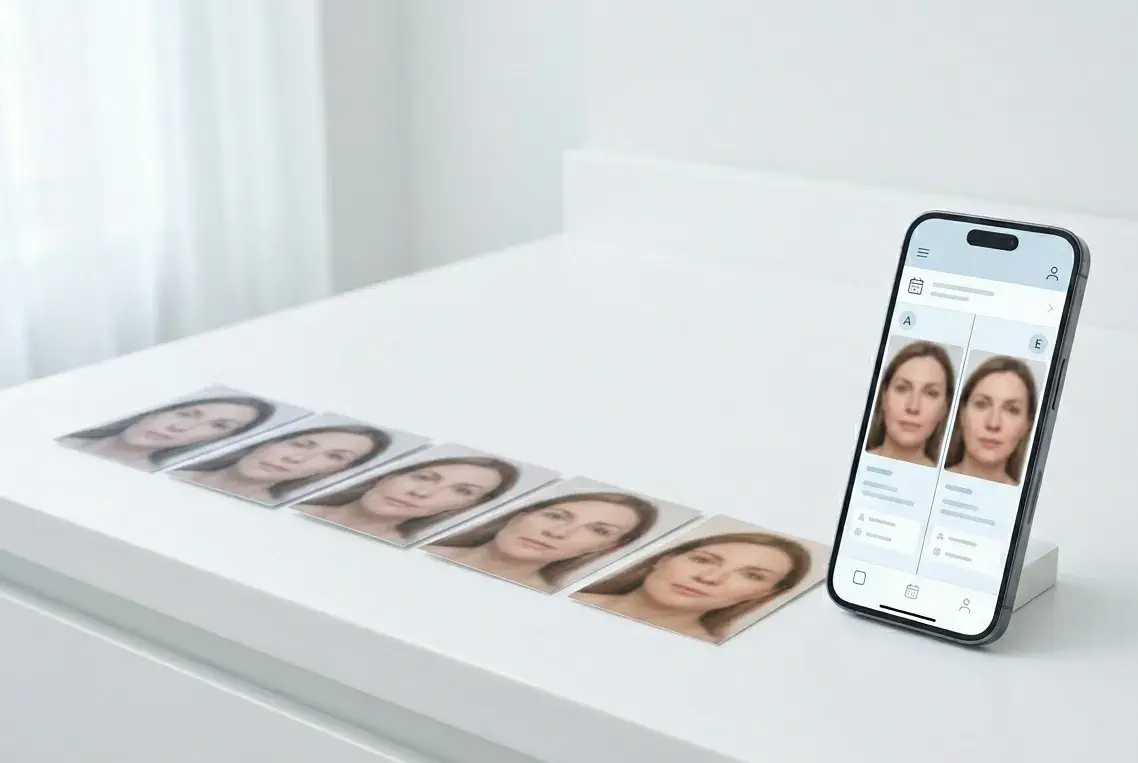
Align every follow-up to that baseline. Same distance, same angle, same framing, same animation states. The most reliable way to do this is a ghost overlay — the previous photo displayed semi-transparently on the camera viewfinder, so the new shot is aligned to the old one at the moment of capture rather than approximated from memory. PixioDoc builds this into its camera, and it turns matching a baseline from a skill into a default.
Show, then ask — never the reverse. At every follow-up, open with the comparison: "Before I ask how you feel, let me show you where we started." Show the baseline on its own first and let it land — that brief pause while the patient re-meets their own before is where the perception gap closes. Then the side-by-side. Then ask how they feel. Anchored to the real before, the same patient who would have shrugged now supplies the enthusiasm themselves.
The cadence follows the treatment: baseline plus day fourteen for toxin; baseline plus the two-to-four-week review for filler, once swelling has resolved; monthly through a biostimulator or contouring course; immediately before each session for cumulative skin treatments, so the stack of change stays visible.
Run this way, the before-and-after also becomes the most honest sales tool in the clinic. A patient who has just watched their own change doesn't need persuading about the next session — the photos carry that conversation. And when a comparison shows a result genuinely below plan, it shows you early, in private, with evidence — which is exactly the conversation you want to be leading rather than discovering in a review.
The ritual does not have to end when they leave the chair. A patient progress report extends the in-room reveal into a PDF takeaway — aligned before-and-afters and treatment notes the patient can revisit at home when memory starts overwriting the result again.
Frequently Asked Questions
Why does my patient say their Botox or filler did nothing?
Almost always because they are comparing against memory rather than evidence. A patient's internal "before" is overwritten by daily mirror exposure while a gradual result settles, so even a strong correction can feel like nothing changed. Check the aligned before-and-after photos first: if the comparison shows the change clearly, the issue is perception and a proper reveal resolves it. If the comparison genuinely shows little change, you have learned something clinically useful instead.
When should I show patients their before-and-after photos?
At every follow-up, before asking how they feel about the result — not after doubt has been voiced. Showing the comparison first anchors the patient to their real baseline instead of their rewritten memory of it. For multi-session courses, repeat the full progression at each visit so cumulative change stays visible rather than dissolving into the day-to-day.
How do I run a before-and-after reveal in a consultation?
Show the baseline photo on its own first and give the patient a moment with it — re-encountering their own before is what closes the perception gap. Then show the side-by-side comparison, and only then ask how they feel. The comparison must be honest to work: same lighting, distance, angle, and animation state, so the only variable in the two frames is the result.
What if the patient still can't see a difference in the photos?
Two possibilities, both useful. If the photos were captured under mismatched conditions, the comparison has failed rather than the treatment — fix the capture protocol so the next pair is genuinely comparable. If well-matched photos truly show minimal change, the photographs have converted a vague feeling into specific clinical information, and the adjustment conversation can proceed on evidence instead of impressions. Either way, you are no longer debating memories.
Do I need consent to take before-and-after photos for consultations?
Yes. Identifiable patient photos are special category data under GDPR, so document consent for clinical photography and store the images in a secure, access-controlled system rather than a personal device or general-purpose cloud drive. Note that consent for documentation is not consent for marketing — publishing a patient's photos on Instagram or your website requires separate, explicit permission for that use. Our guide to GDPR-compliant medical photography apps covers the storage side in detail.
The Reveal Is Part of the Result
In most of medicine, a result exists whether or not the patient perceives it. Aesthetic medicine is harder: the perceived result is the product. You can change a face and still fail to change a mind — and the rebooking, the package, the referral, and the review all live in the mind.
The before photo is the bridge, but only if it exists, only if it matches, and only if it is shown before doubt speaks first. Treat the comparison as part of the treatment — captured with the same discipline, delivered at every follow-up — and the patient who once said "I'm not sure it did much" becomes the one holding up their own timeline, asking what's next.
Ready to make every result visible? Start free with up to 10 patients; upgrade to Pro for ghost-overlay capture, a chronological timeline per patient, and one-swipe side-by-side comparison built for the consultation-room reveal — with every photo encrypted, EU-hosted, and out of your personal gallery. Download PixioDoc and run your first reveal this week.
Keep patient photos out of your camera roll
PixioDoc gives you a dedicated workspace to capture, compare, and share patient photos — organized by patient timeline, never mixed with your personal gallery.
EU-hostedEncrypted in transit & at rest
Keep reading
Medspa Photo App: Document Botox, Body, and Laser Treatments in One Workflow
How medspas document injectables, body contouring, laser, and peel results in one patient timeline — and what to look for in a medspa photo app.
Read article
How to Take Consistent Before-and-After Photos for Botox and Filler
A practical photography workflow for aesthetic injectors — repeatable lighting, the right view set for toxin and filler, animation states that actually compare, and the storage rules medspas keep getting wrong.
Read article
Patient Progress Reports: Why They Matter and How to Share Them Safely
Why patient progress reports and PDF treatment summaries matter for referrers, patients, and insurers — and how to share clinical photos as a structured report without assembling documents by hand.
Read article